AI Human
Seven questions to ask before you launch anything
October 6, 2026
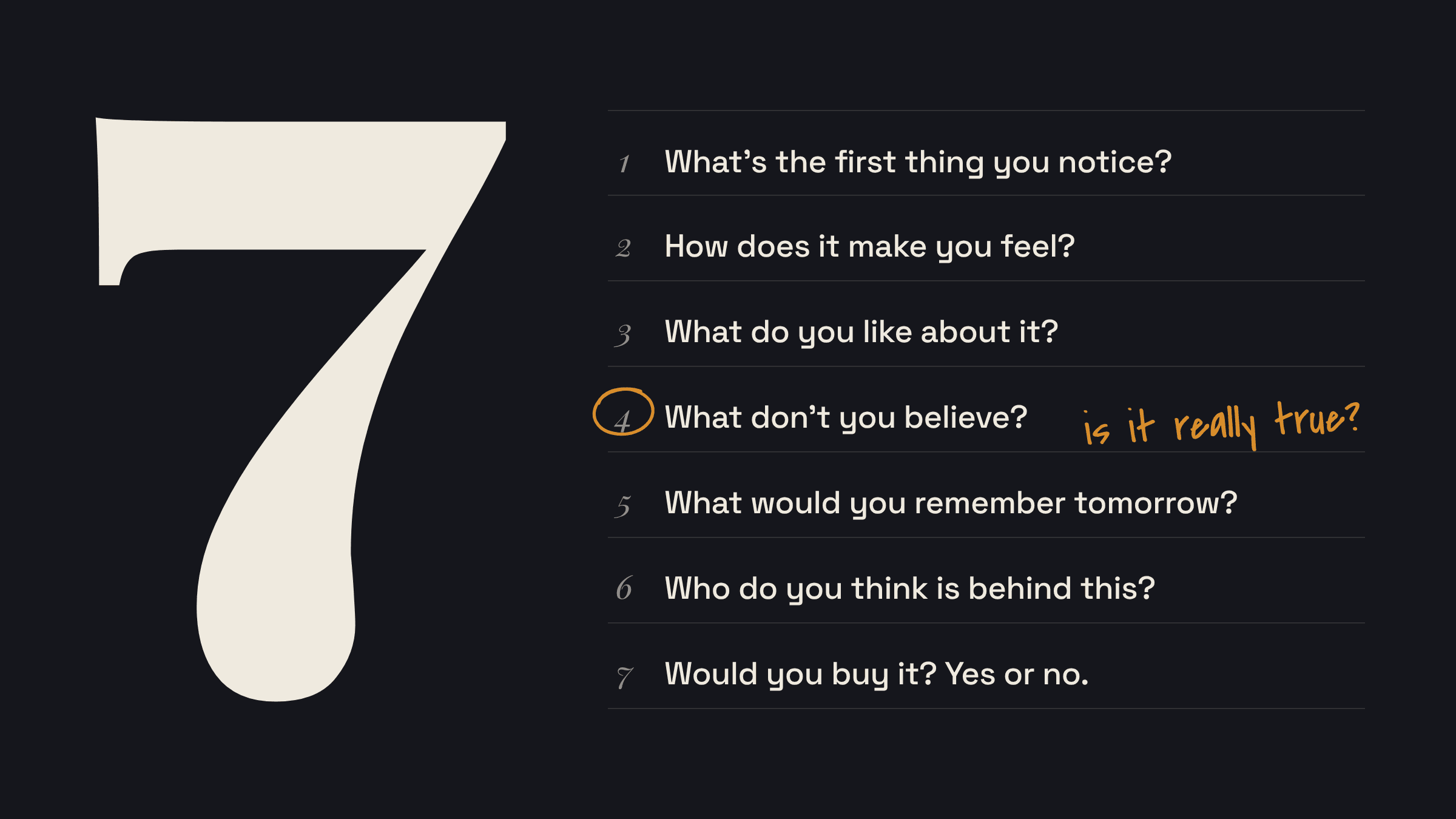
Every panelist in a Valid8 test answers the same seven questions. They answer alone, without seeing what anyone else said. People outside your target audience are left out instead of being counted as a no.
None of the seven is clever, and that's sort of the point. They're what you'd ask a friend if you slid your phone across the table and said "be honest." The only difference is that we ask all seven, every time, in the same order, and we write the answers down before anyone gets a chance to argue with them.
You don't need us to use them. Take whatever you're about to put out (an ad, a landing page, a price change, a note to customers), show it to five people who might actually buy from you, and ask. Here are the seven, and what each one tends to catch. The examples come from a phone ad we tested recently.
1. What's the first thing you notice?
You decided what people should see first. They didn't get the memo.
In the phone ad, the price showed up in most of the first answers. One panelist's whole reply was that it "stands out immediately." Another went straight to a "No. 1 selling" claim. In the answers we printed in the report, nobody opened with what the phone can actually do.
That's fine if you set out to make an ad about a price. It's a problem if you thought you were making one about a phone.
2. How does it make you feel?
People answer this in a handful of words, and they're rarely the words in your brief. One panelist said the phone ad "feels like a typical promotional ad trying to create urgency."
The answer to worry about isn't "annoyed." Annoyed people at least noticed. "Typical" is worse. Typical is what people call something they've already scrolled past.
3. What do you like about it?
Ask this even when you already know the thing has problems. It tells you what to leave alone.
The panel liked two things about the phone ad: the price was stated plainly, and it mentioned early access during a sale. Those are the kind of plain details that get cut first when a nervous team starts rewriting at midnight.
4. What don't you like, or what don't you believe?
If you only keep one question, keep this one.
The same ad carried a "No. 1 selling" claim, and the panel didn't believe it. One answer ended with "is it really true?" Others said the same thing more politely: they'd want to see the data first.
The trouble with doubt is that it's quiet. Nobody complains about a claim they don't believe. They just discount everything that comes after it. And a line like that sails through approval, because everyone in the approval meeting already believes it.
5. What would you remember tomorrow?
Noticing and remembering are two different lists, and the second one is shorter.
For the phone ad, people said they'd remember the price and the sale. The feature line on the ad didn't come back as a theme at all. Ask the people who made that ad what it was about, and we'd bet "the sale" isn't what they'd say.
6. Who do you think is behind this?
We ask what kind of company they think is talking to them.
The phone brand is a household name, so the answers were what you'd expect: established, trusted. But one panelist added that the brand was presenting itself as a market leader and that they questioned its claims. One line they didn't believe had already leaked into what they thought of the company.
If you're not a household name, this question matters more. Whatever people say here is your positioning. The version in your deck is a hope.
7. Would you buy it? Yes or no.
The verb changes with what you're asking people to do (buy, sign up, book). The yes or no stays. People are polite, and "maybe" is how polite people say no.
This answer becomes the big number on the front of our reports. On its own it's the least useful of the seven. It tells you that something is wrong. The other six tell you what.
If you try this yourself
A few rules we'd stick to.
Ask people who could plausibly buy. Your team doesn't count, and neither does your agency. Your spouse counts only if your spouse is the customer.
Ask them one at a time. In a group, the first confident person answers for everyone else.
Show it the way they'd actually meet it: on a phone, for a few seconds, with no introduction. Then don't explain it and don't defend it. The moment you say "what we were going for is," you're testing your explanation.
Write down their exact words. Your summary will be kinder than they were. "A typical promotional ad trying to create urgency" turns into "liked the urgency" very easily when the person taking notes also wrote the ad.
Keep the numbers in proportion. Five people give you a direction, not a measurement. If four of the five doubt the same line, fix the line. If they split on the background color, pick one and move on.
Where an AI panel fits
Five real people is the right answer when you have a week. Most launches don't have a week.
That's the gap we built Valid8 for. It puts the same seven questions to a panel of AI personas, some built from Indian shopper profiles and some from real interviews, and scores only the ones who match the audience you describe. You can test a version, change a line, and test it again.
It has limits, and we print them on every report. It predicts how people respond. It doesn't forecast clicks, click-through rate or return on ad spend. Run the same ad twice and the score can move by about ten points, so a three-point gap between two versions means nothing.
What it's good at is the fourth question. It finds the line nobody believes before you pay to show it to everyone.